Trial by combat
The Last DuelTrial by combat was a formal legal procedure that made a physical contest the means of deciding whether a party had sworn falsely. Unlike a duel of honor, it was governed by law and authorized by a court; its result was understood as the Judgment of God. The procedure’s decisive paradox was that a staged, public fight could deliver an enforceable verdict, even when it could not establish what had actually happened. In the late fourteenth century, that paradox was played out before thousands of spectators in the case of Jean de Carrouges and Jacques Le Gris, the last judicial duel authorized by the Parlement of Paris.
Definition and Historical Background
Trial by combat, also called judicial combat or wager of battle, was distinct from a private duel undertaken to answer an insult. It was a method of adjudication: the parties’ competing claims and oaths were put to a test in which the outcome was expected to identify the false swearer. The belief that God would determine the result gave the procedure its religious meaning as well as its legal force. The contest was not simply a test of arms; within its governing logic, its outcome was evidence.
The custom was ancient in France, particularly in Normandy. In earlier periods, people of different social ranks could resort to judicial combat, and public contests were used to address both felonies and civil disputes, including questions of property. In some parts of Europe, women could also fight men. Jean de Carrouges and Marguerite de Carrouges had ancestors who served as pledges, or sworn seconds, in judicial duels, a reminder that the practice belonged to a longstanding social and legal tradition rather than to a single exceptional case.
That tradition was narrowing by the later Middle Ages. Popes condemned the duel as an attempt to test God and as contrary to Scripture. Kings, meanwhile, had a political reason to resist it: judicial combat could preserve the authority of powerful barons at a time when monarchs sought to gather judicial power around the throne. The procedure therefore stood between competing sources of authority. It claimed divine validation, operated through legal rules, and could also limit the reach of royal justice.
Legal Threshold and Personal Stakes
The restrictions were explicit in Philip IV’s 1306 decree on judicial combat, which remained in force when Jean de Carrouges appealed to the king in 1386. A case had to satisfy four conditions: the alleged crime had to be capital, such as murder, treason, or rape; the occurrence of the crime had to be certain; other legal remedies had to be exhausted, leaving combat as the only means of conviction; and the accused had to be strongly suspected. Combat was thus not supposed to be a routine option or a substitute for ordinary proceedings. It was reserved for a narrow class of cases after other avenues had been tried.
The legal test placed grave risks on the person who demanded battle. Jean de Carrouges put his life, estate, and family’s reputation at stake. His oath also implicated his soul: if the combat established that he had lied, the consequences were understood to reach beyond earthly punishment. The procedure demanded more than a willingness to fight. It required a claimant to stake his honor and future on the claim that the contest would vindicate him.
Because Marguerite de Carrouges was the chief witness to the accusation against Jacques Le Gris, the wager extended to her as well. She had to swear to her charge; if Jean lost as her champion, the procedure would treat her as a false accuser. Perjury in a capital case could be punished by death, and a woman found to have sworn falsely about rape could likewise face execution. Trial by combat therefore made a woman’s testimony consequential while exposing her to the most severe penalty if the contest turned against her. The procedure’s formal test of truth carried a severe and unequal human cost.
Challenge and Conduct of the Procedure
The challenge itself was ritualized. After naming and accusing his opponent, the claimant threw down a gage of battle, traditionally a gauntlet or glove. The gesture pledged him to meet the accused in the enclosed field, or champ clos, if the court decided that combat should proceed. The accused then lifted and took up the gage, signifying acceptance of the challenge and an undertaking to defend his claim in battle if the court ordered it. These gestures converted accusation and response into public, formal acts; neither was merely an expression of private hostility.
The Parlement of Paris considered the case against a background of repeated refusals to authorize such contests. It had not approved a duel in an alleged rape case since 1354, and it had rejected requests for judicial combat in several cases between 1330 and 1383. In 1386, however, it ordered a trial by combat between Jean de Carrouges, knight and appellant, and Jacques Le Gris, squire and defendant. Le Gris sought to have the accusations dismissed and to be completely exonerated. He also counterclaimed that Carrouges had gravely damaged his reputation by publicly accusing him, and demanded 40,000 gold francs in damages.
The legal decision did not make the underlying dispute transparent. The parties testified in Norman French, but no transcript of their spoken testimony survives. The official record is a Latin summary, produced by a court scribe and preserved in a unique manuscript of nearly ten densely written folio-sized pages. It records Carrouges’s itemized charges, based on his wife’s sworn testimony, and Le Gris’s substantial defense. The surviving account is detailed, yet it is still a summary rather than a record of every word spoken. That distinction matters: the procedure depended on testimony and oaths, while what remains for later readers is mediated by an official written account.
The Field, Ritual, and Possible Verdicts
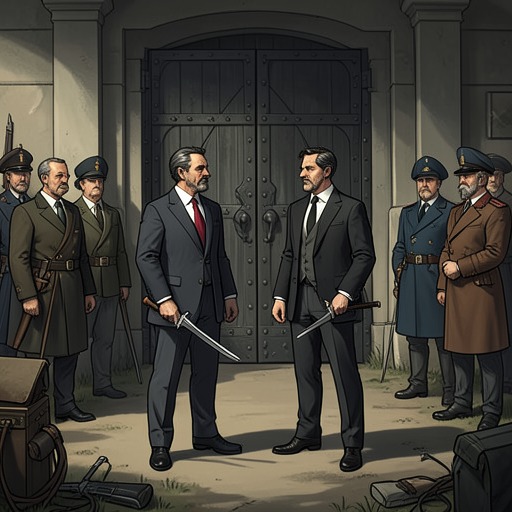
The authorized contest was staged at Saint-Martin-des-Champs Priory in Paris, whose grounds included a field for combat and room for a large audience. Thousands gathered there: most were commoners from the city or its suburbs, while nobles, members of the royal court, and visitors from elsewhere expected places to watch. A rectangular field enclosed by a high wooden wall formed the contest space, with guards stationed around it. The public setting made the verdict visible to the city, but the enclosure also confined the fighters to the procedure’s terms.
Charles VI was both the most exalted spectator and, by law, the presiding judge. The Parlement had authorized the contest in the king’s name. Charles postponed it for a month so that he could attend after returning from Flanders, and insisted that proceedings not begin until he arrived. Once he took his place in the royal stand, the ceremonies began. The king’s presence joined the authority of the court to the claim that the contest would disclose a divine judgment.
The combatants’ equipment was subject to inspection. The herald, assisted by officials assigned to the two men, examined their weapons to ensure that no forbidden devices had been brought into the field and that their lances, swords, axes, and daggers were of equal length. The rules also specified that a weapon forbidden by French law would be confiscated and not replaced. Such checks made the contest a regulated proceeding, not an unrestricted fight, and sought to establish formally that neither combatant entered with an illicit advantage.
Religious ceremony framed the legal and physical contest. Priests placed an altar at the center of the field, covered with gold cloth, and set upon it a silver crucifix and a prayer book opened to an image of Christ’s Passion. The combatants swore three formal oaths. A priest reminded them that the result would imperil the guilty party in both soul and body because of the oaths they had taken. The sacred objects and spoken vows presented the fight as a divine judgment, while the king, court, and legal officers organized its earthly proceedings.
The procedure allowed for more than one ending. A combatant might kill his opponent, which would establish the truth of his charge and his enemy’s guilt; force the opponent to confess to perjury, leading to execution by hanging; or drive him from the field, which also counted as proof of guilt and brought condemnation. A further danger applied to Carrouges: even if he yielded before being killed, he could be taken from the field and hanged as a proven liar. These alternatives show how combat translated different outcomes into a single legal framework of proof and punishment.
Verdict, Uncertainty, and Decline
The 1386 contest was the last judicial duel sanctioned by the Parlement of Paris. Later requests for trial by combat came before the court, but none resulted in an order authorizing one. The duel’s controversial outcome has been said to have hastened the decline of an institution increasingly regarded as barbarous. Its end was not simply a matter of changing taste: the old procedure had already been constrained by legal thresholds, opposed by church authorities, and challenged by the centralizing ambitions of kings.
The accounts of the immediate reaction do not establish a single public consensus. Jean Froissart, writing within a few years, said that the king, court, and crowd rejoiced at the result. Jacques Le Gris’s lawyer, Jean Le Coq, recorded mixed responses: some considered Carrouges vindicated, while others believed Le Gris had been unjustly killed. The disagreement survived alongside the official legal outcome. A verdict could settle the case in law without settling how every observer understood it.
Nor did the result resolve the historical question of what happened to Marguerite de Carrouges. The surviving evidence and later commentary have sustained competing interpretations, but the book emphasizes that the truth cannot be recovered to everyone’s satisfaction. The episode illustrates a limit inherent in the procedure: a fight could impose a judgment and determine the parties’ legal fate, yet its outcome could not be independently checked against the event it purported to decide. The law treated victory as proof by divine will; later readers encounter that claimed certainty through records and accounts that preserve disagreement.
The contrast between the duel’s medieval public form and its later fate is stark. In its earlier setting, combat was an elaborate civic and religious spectacle, with challenges, armor, oaths, priests, royal authority, and a crowd assembled around a walled field. In later centuries, the duel receded into private, illegal encounters, detached from the formal court ceremony that had once made it a recognized mode of judgment. The trial of Carrouges and Le Gris thus marks both the climax of a long legal ritual and the closing of its most visible chapter: the last time the Parlement of Paris allowed a combat to speak as law.